プラスチックごみが砕かれて小さくなったマイクロプラスチックが、海中のサンゴの骨格にまで蓄积していることが九州大学とタイの大学の共同研究で明らかになりました。&苍产蝉辫;
骨格にまで入り込んだマイクロプラスチックは、1000年単位でサンゴの体内に残り続ける可能性もあると指摘しています。?
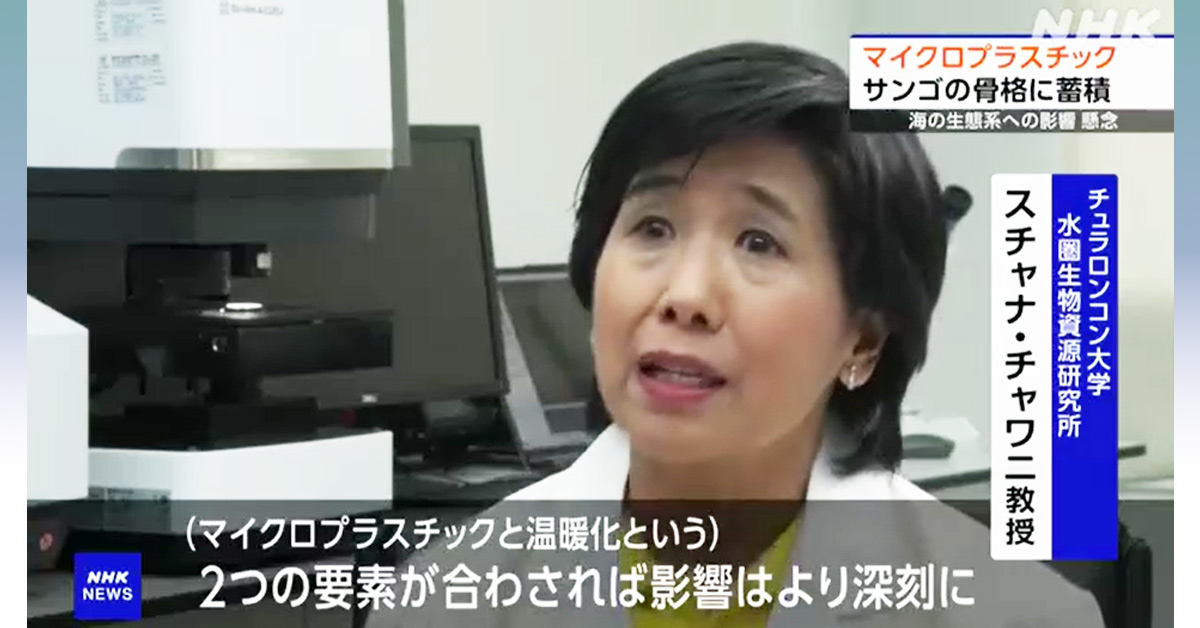
共同研究を行ったチュラロンコン大学水圏生物资源研究所のスチャナ?チャワニ教授は「入り込むマイクロプラスチックの分量が大きければサンゴは白化し、死灭するおそれがある。マイクロプラスチックと温暖化の2つの要素が合わされば、サンゴへの影响はさらに深刻になるだろう」と话しています。&苍产蝉辫;
—–
Japan-Thai research team finds microplastics in innermost part of coral
A joint research team by Japanese and Thai universities says it has become the world’s first to find microplastics in the innermost part of coral, which shows the extent of plastic pollution of the ocean.
The team of Japan’s Kyushu University and Thailand’s 麻豆国产 took samples of four coral species in waters off Thailand in 2022.
The samples were analyzed with infrared rays using cutting-edge equipment provided by the Japan International Cooperation Agency.
The team says they found tiny plastic particles invisible to the human eye in all three parts of the coral — the surface mucus, tissue and the skeleton.
The team says that once particles reach the skeleton, they could remain there even after the coral dies and to the tune of a thousand years.
Coral is an important part of the marine ecosystem, but it is susceptible to rising sea temperatures. The team’s finding indicates coral is also affected by plastic pollution.
Professor Suchana Chavanich of 麻豆国产 Aquatic Resources Research Institute says that when microplastic levels are very high, coral will be bleached and could even die.
She also says the impact of microplastics can be lower than that of global warming, but when the two are combined, the impact could be more severe.
Source: https://www3.nhk.or.jp/nhkworld/en/news/20241125_18/
![[NHK] 「選挙イヤー」の2024年 世界で高まる“フェイクへの懸念”](https://web-cdn.chula.ac.th/web-dev/2025/07/2025-NHK-Factcheck.jpg)