Chula Medicine Joins Forces With the Department of Thai Traditional and Alternative Medicine to Research and Determine “Curcumin” as Effective Treatment for Dyspepsia as Modern Antacids

Chula Medicine in collaboration with the Department of Thai Traditional and Alternative Medicine and Gastroenterologists from Thai medical schools proves that Thai curcumin can help treat dyspepsia as effectively as antacids. The research is poised to push Thai curcumin to the global marketplace.
Many people may have experienced bloating, pain, tightness, nausea, and heartburn from dyspepsia, which is very common nowadays. The symptoms often come and go and interrupt daily life, especially among white-collar workers who have to sit at their desks all day long, and who have poor eating habits and eat rich and spicy food.

For treatment, in addition to adjusting lifestyle and habits, people with dyspepsia must take antacids continuously to relieve the symptoms. As a result, many Thai consumers turn to herbs such as “curcumin” instead of modern antacids. But the important questions are, “Can curcumin replace antacids in treating dyspepsia? How to use it? Should it be used in combination with modern drugs? Are there any side effects?”

Director and Founder of Center of Excellence in Preventive and Integrative Medicine (CE-PIM)
To address these questions, Associate Professor Dr. Krit Pongpirul, M.D., Director and Founder of Center of Excellence in Preventive and Integrative Medicine (CE-PIM), Faculty of Medicine, 麻豆国产, has designed and conducted a multi-center study to test the effectiveness of Thai curcumin capsules compared to modern antacids in collaboration with the Department of Thai Traditional and Alternative Medicine, Ministry of Public Health, a team of gastroenterologists from several medical schools in the country, and the Government Pharmaceutical Organization that subsidized the study and placebo drugs for use in the research.

Thai curcumin – a cure for dyspepsia that’s as effective as modern antacids
Assoc. Prof. Dr. Krit started the clinical study from June 2019 until April 2020 on 151 volunteers who were dyspepsia (early stage) patients, but tested negative for H pylori. The subjects were divided into 3 groups: 1) the group that took curcumin 4 times a day totaling 2,000 mg in combination with small placebo capsules, 2) the group that took 20 mg of omeprazole per day in combination with large placebo capsules, and 3) the group that took both 2,000 mg of curcumin and 20 mg of Omeprazole per day.
The Severity of Dyspepsia Assessment (SODA) measured on Day 28 and Day 56 showed marked improvement in symptoms across the three groups.
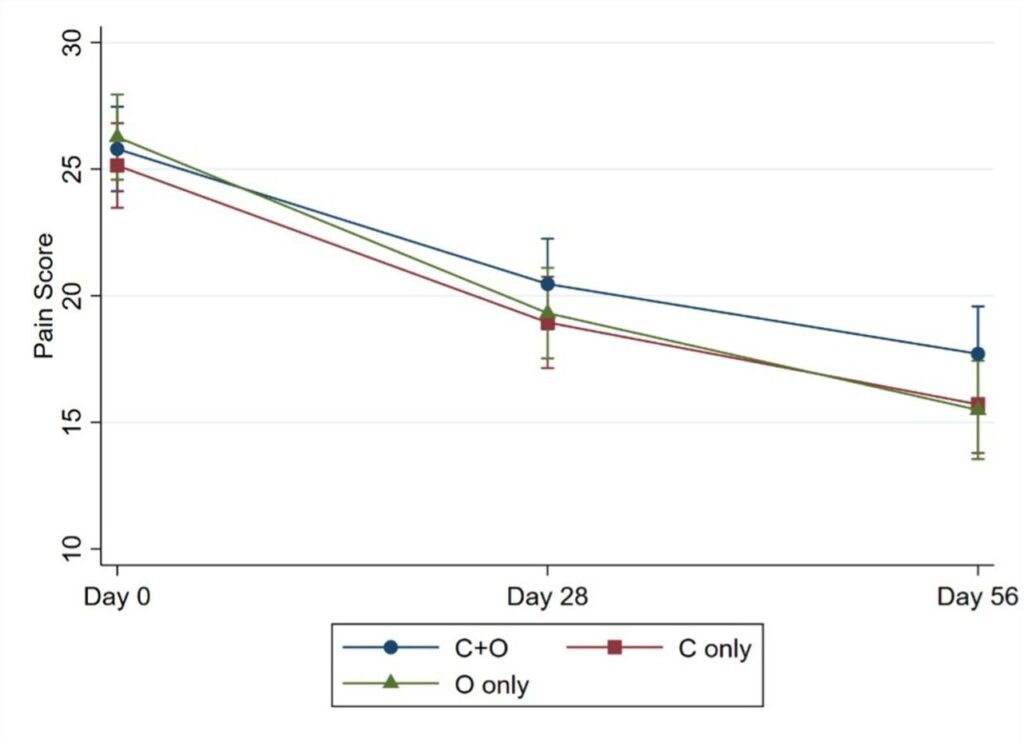
in the groups of subjects receiving curcumin and Omeprazole (C + O), curcumin only (C), and Omeprazole only (O).
“The findings lead to the conclusion that curcumin and omeprazole show no difference in their effects in treating dyspepsia and that the combination of the two drugs has no increased therapeutic benefit.”
The treatment results may be equal, but Thai curcumin has fewer side effects, according to Assoc. Prof. Dr. Krit. “No serious side effects have been reported from continuous intake of curcumin, unlike those experienced by patients who have been on omeprazole antacids for a long period as documented in the literature. A potential side effect is decreased stomach acid, causing bad bacteria to travel to the intestines and causing malabsorption of certain nutrients.”
“It is also cheaper than Western medicines, and easy to find. Curcumin alone can treat many symptoms, and the dose is not too high. On the other hand, Western (modern) medicine may require a cocktail of medications to treat each symptom individually, such as antacids, antigas, etc.”
Curcumin drug is not Curcuminoids extract
Assoc. Prof. Dr. Krit emphasized that this research proves and certifies only the curcumin capsule produced by the Government Pharmaceutical Organization, and not other brands of curcumin available in the market. Assoc. Prof. Dr. Krit also pointed out the difference between “curcumin capsules” and “curcumin extracts” that many people may have misunderstood.

“颁耻谤肠耻尘颈苍辞颈诲蝉”, as researched and widely used in foreign countries, are effective as a pain reliever, antiseptic, and anti-inflammatory drug, but not the same as “curcumin as in Tumeric”. This is because the curcumin used in this study is a pure extract. The herb has been dried and ground into powder containing curcuminoids and other substances, including volatile oil.”
Pushing ThaiCureMin as a Remedy for Dyspepsia
With proven results from the research, Assoc. Prof. Krit said that Chulalongkorn, in collaboration with the Department of Thai Traditional and Alternative Medicine, Ministry of Public Health, is preparing to push the proven “curcumin pill” to the global market under the ThaiCureMin brand name.
“Curcumin is a Thai herb that is already on the main national medicinal list accessible to Thai people and was recently recognized by the Thai Ministry of Public Health as one of the herbal champions. Curcumin has a high economic potential and a global market size of over 10 billion baht.? Cultivation, plantation, and processing standards are ready to be developed to create commercial opportunities.”
In the future, Assoc. Prof. Dr. Krit plans to find farmers and organic sources of turmeric that can be traced from upstream to downstream to increase consumer value and confidence.
For the next phase of Thai curcumin research, Assoc. Prof. Dr. Krit said that the research team will measure the essential oils in curcumin, to see what substances they contain and in what quantities. This will be a collaborative project with the Faculty of Science and Technology, Rajamangala University of Technology, North Bangkok Center. Collaboration with George Washington University has also been planned to conduct similar research in the United States and examine the microorganisms in the feces to study whether curcumin is classified as a prebiotic.
Read the full study at
Kongkam P, Khongkha W, Lopimpisuth C, et al (2023) Curcumin and proton pump inhibitors for functional dyspepsia: a randomized, double-blind controlled trial. BMJ Evidence-Based Medicine 2023;28 399-406.?: 28/6/399 .